
Services
Palo Alto Disinfection and Sanitizing
Commercial disinfecting services for Palo Alto restrooms, break rooms, entries and shared equipment, folded into your recurring visits or booked as a single focused visit.
Shared surfaces your people can trust
Every workday in a Palo Alto building leaves its mark on the same few hundred surfaces: the front door pull, the elevator call button, the coffee machine, the faucet lever in the restroom. Palo Alto Janitorial gives those points a disinfecting step of their own, so the places everyone handles get more than a quick wipe.
You can make it part of the routine, with disinfection built into each recurring janitorial visit, or call for it when you need it, as a focused visit that covers the whole building or only the rooms you choose. Either way you get a written touchpoint list, a schedule that fits your hours and background-checked cleaners on every visit.
Soil comes off, then the disinfectant goes on
A disinfectant works on a bare surface, not on a layer of fingerprints, coffee drips and dust. So each point on the list gets two passes. The first uses a detergent and a fresh cloth to lift the grime that would otherwise shield the surface. The second applies the disinfectant and leaves it in place for the full dwell time the manufacturer sets, before the surface is wiped or left to air dry.
Cloths are kept separate by area, so the ones used around toilets and urinals never travel to a kitchen counter or a conference table. Products are never combined, and rooms with closed windows get their ventilation running while the work is underway. Sanitizer goes where it fits best, such as break room tables, and disinfectant goes on the restroom fixtures and hand-contact hardware that see the most traffic.
Commercial disinfecting services, defined in plain terms
Cleaning, sanitizing and disinfecting are three different steps, and the EPA and CDC use each word for a specific job. Cleaning removes dirt, dust and grime from a surface with detergent and water. Sanitizing lowers the number of germs on a surface, and it suits places such as break room tables and counters where food is set down. Disinfecting applies an EPA-registered disinfectant to a surface that has already been cleaned, left wet for the dwell time on its label.
Our commercial disinfecting services use all three in order, and the written list shows your facilities team which step every surface receives. Restrooms that need more than a nightly pass can add restroom deep cleaning as a periodic visit of its own.
The touchpoints on a Palo Alto route
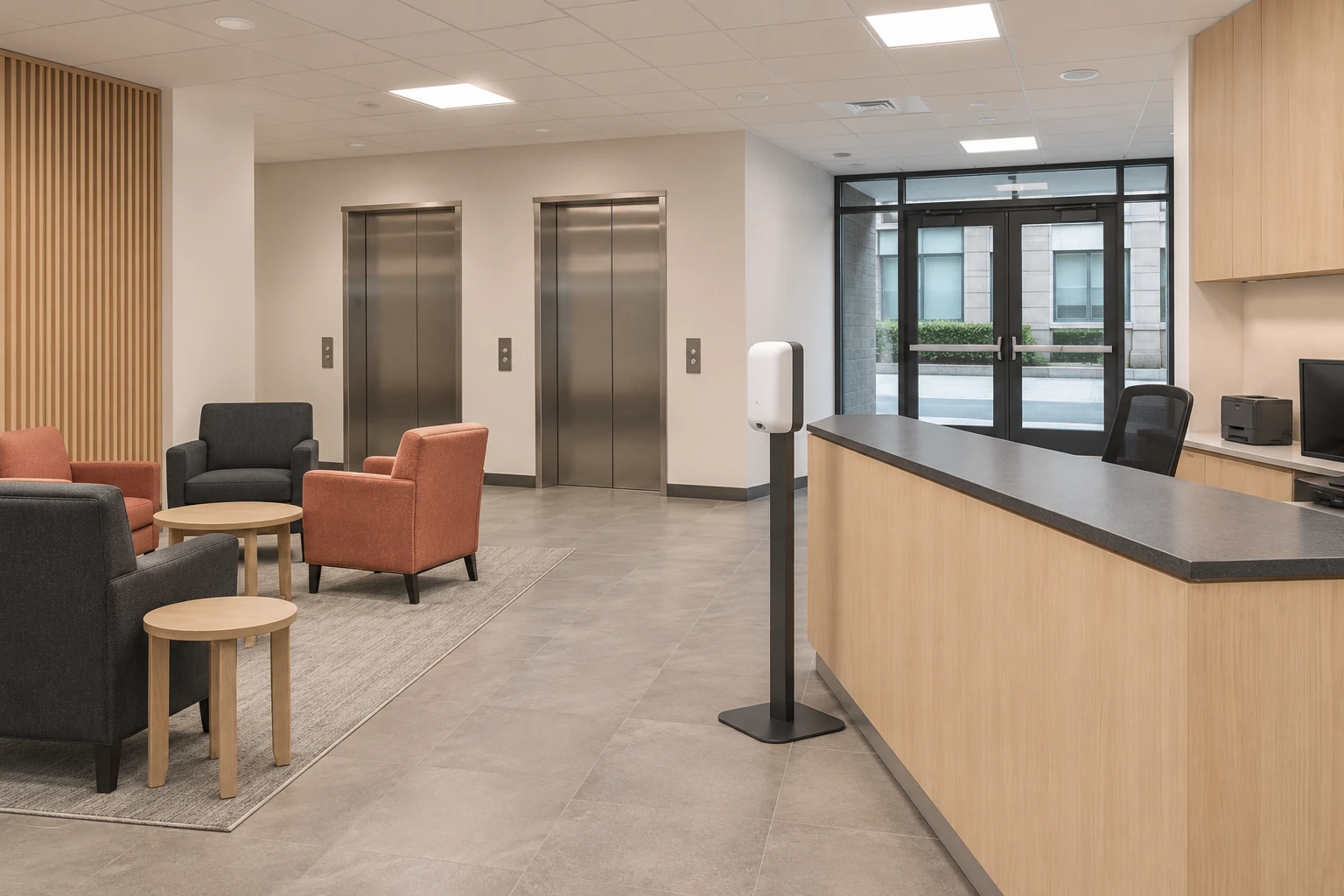
Entry areas come first. Door pulls and push plates, handrails, elevator buttons, badge readers and the reception counter are the surfaces nearly every visitor and employee touches before they reach a desk.
Restrooms follow: flush handles, faucet levers, partition latches, soap and towel dispensers, baby-changing stations and the inside handle of the exit door. In the break room the list takes in the fridge door, the microwave keypad, the espresso or coffee machine controls, water dispenser paddles, sink edges and the tabletops where people eat.
Shared equipment rounds out the route. Copier and printer panels, conference room tables, speakerphones, shared keyboards and the touchscreens outside meeting rooms are treated with products suited to electronics, applied to a dampened cloth rather than sprayed on the device.
Built for the buildings Palo Alto works in
Research park floors run on shared lobbies, kitchens and meeting rooms that host a steady flow of visitors. In research buildings, the touchpoint list follows badge access and the hours each floor goes quiet, and it pairs with our laboratory cleaning.
Professional suites and storefronts see a new set of hands at the counter every few minutes. For medical offices, waiting rooms and check-in counters belong on the list after every clinic day. For retail stores, the focus is the staff rooms, stockroom doors and employee restrooms behind the sales floor.
Classrooms and childcare rooms get the same care on desks, cubby handles, sink taps and the doors children push open dozens of times a day.
Nightly rounds, daytime passes and one-off visits
Most buildings keep disinfection on the evening route. The touchpoint list runs after your team leaves, so every handle and button is ready when the first badge swipe of the morning opens the door.
Busy floors can add a daytime pass. A day porter works through restrooms, break rooms and the entry hardware around the lunch hour, which suits buildings that fill early and stay full until evening.
A one-off visit covers the moments that call for extra attention: a stretch when several people in one department are out sick, the week a team moves into a new floor, or the morning before a large customer event in your lobby. Tell us which rooms matter most and the visit is planned around them.
What shapes the price of disinfection
Disinfection is priced from the list, not from a flat add-on. The number of touchpoints per room counts most: a restroom with six stalls or a shared kitchen holds far more hand-contact surfaces than a private office of the same size. How often each list runs comes next, since a nightly route and a weekly route cost very different amounts over a month.
Daytime passes are billed as porter hours on top of the evening service. A single focused visit is priced on its own, by the rooms included and the hours it takes. Products your facility already specifies, electronics that need careful handling, and buildings where badge or escort rules shape the visit all add time. Our Palo Alto cleaning rates guide shows how the recurring service around it is priced.
A free walkthrough sets the list room by room, and the written quote prices exactly that list, with no guesswork on either side.
Common questions
Can the conference rooms we book by the hour be treated between meetings?
Yes. A day porter can reset the table, chairs, speakerphone and room touchscreen between bookings, and the evening route covers them again after the building empties.
Will you work from the touchpoint list our facilities team already keeps?
Yes. We start from your list, walk the building to confirm each point, and add any surfaces the walkthrough turns up so the route matches how people really use the space.
Can disinfection cover only our suite in a multi-tenant building?
Yes. The route covers the rooms you lease, from your suite entry and restrooms to your kitchen and meeting rooms, while the building’s shared lobby stays with whoever cleans it today.
Does adding disinfection raise our monthly janitorial price?
It adds a modest amount of time to each visit, so the monthly figure rises in step with the touchpoints and nights you choose. A walkthrough sets the list, and the quote shows the cost of that list clearly.
Are badge readers and visitor sign-in tablets included?
Yes. They go on the entry list and are treated with a product suited to electronics, applied to a damp cloth so no liquid runs into the screen or the reader.
How does sanitizing differ from disinfecting on our touchpoint list?
Sanitizing lowers the number of germs on a surface and fits food areas such as break room tables. Disinfecting applies an EPA-registered disinfectant to a cleaned surface for its full label dwell time, and it is used on restroom fixtures and high-touch hardware.
Can we book commercial disinfecting services as a one-time visit?
Yes. A single visit can cover the whole building or only the rooms you choose, priced by the rooms and hours involved, and it can run in the evening or over a weekend.